 LuxuryCroatia.net
(H-KK-VO-SI)
Stone house in row for sale, Vodice, Sibenik
Stone house in row for sale, Vodice, Sibenik , it has a living space of 160 m2, and consists of 4 bedrooms total and 2 parking places.
SOLD!
Sibenik is a historic city located in the central part of the Croatian coast on the Adriatic sea where the beautiful river Krka flows into the Adriatic. It is a centre of the county of Sibenik and Knin and it extends along the 100 km long coastline from Zadar to Split while laying under the Dinara mountain in the hinterland area. The city is different from other cities on the coast because it was founded by Croats and not by Greeks, Illyrians or Romans, meaning it is the oldest native Croatian city on the Adriatic.
For a while, Sibenik was a seat for the Croatian king Kresimir the fourth so it is sometimes called the Kresimir’s city. Sibenik’s rich history and appearance was influenced by Venice, Byzantium and Hungary who were tossing Sibenik around in the 11th and 12th centuries, and in the 14th century, the hinterland of Sibenik accomodated the Vlachs. Today, Sibenik has good connections to the surrounding areas, all due to its good road traffic position, and the air traffic which is available from Split’s Kastela Airport (45 km away) or Zadar’s Zemunik Airport (50 km away).
When Sibenik was given the official status of a town in the 13th century, the construction of today’s symbol of Sibenik began, the cathedral of St. Jacob.
If you want to know more about Sibenik, click here: Sibenik.
Sea view house in center of Vodice, Sibenik
(H-CV-SI)
Sea view house in center of Vodice, Sibenik is located in the center of the town (semi-detached), 270 m2 living area:
Ground floor: cellar, garage, yard
First floor: 1 apartment, 2 bedrooms, bathroom
Second floor: 2 bedrooms, bathroom, terrace
Third floor: bedroom, bathroom, terrace
-air conditioning, solar
Energy certificated with class C. Total 5 bedrooms.
Sibenik is a historic city located in the central part of the Croatian coast on the Adriatic sea where the beautiful river Krka flows into the Adriatic. It is a centre of the county of Sibenik and Knin and it extends along the 100 km long coastline from Zadar to Split while laying under the Dinara mountain in the hinterland area. The city is different from other cities on the coast because it was founded by Croats and not by Greeks, Illyrians or Romans, meaning it is the oldest native Croatian city on the Adriatic.
For a while, Sibenik was a seat for the Croatian king Kresimir the fourth so it is sometimes called the Kresimir’s city. Sibenik’s rich history and appearance was influenced by Venice, Byzantium and Hungary who were tossing Sibenik around in the 11th and 12th centuries, and in the 14th century, the hinterland of Sibenik accomodated the Vlachs. Today, Sibenik has good connections to the surrounding areas, all due to its good road traffic position, and the air traffic which is available from Split’s Kastela Airport (45 km away) or Zadar’s Zemunik Airport (50 km away).
When Sibenik was given the official status of a town in the 13th century, the construction of today’s symbol of Sibenik began, the cathedral of St. Jacob.
If you want to know more about Sibenik, click here: Sibenik.
Big apartment house for sale, Vodice, Sibenik
(H-SI-BAP)
Big apartment house for sale, Vodice, Sibenik consists of 12 apartments, 9 parking places, separated (judicial and land registry). The house is fully furnished and in a quiet location. It is ideal for a family that wants to engage in tourism.
– Beach 250m
– Station, market, hospital 600m
– Guidance Centre 700m
– Basement 12 m2
– Ground floor 111.77 m2 (4 apartments: 3-one bedroom and one two bedroom apartment)
– Floor 125.40 m2 (4 apartments: 3-one bedroom and one two bedroom)
– Attic 135.39 m2 (4 apartments, 3-one bedroom and one two bedroom)
-common areas (2 pantry, cellar, laundry-engine: a total of 60 m2)
– Surface area of approximately 600 m2
-CENTRAL solar water heating (boiler 750L)
-septic and water-repellent
-PRICE IS REDUCED FROM € 700,000.00 € 500,000.00 ON
Sibenik is a historic city located in the central part of the Croatian coast on the Adriatic sea where the beautiful river Krka flows into the Adriatic. It is a centre of the county of Sibenik and Knin and it extends along the 100 km long coastline from Zadar to Split while laying under the Dinara mountain in the hinterland area. The city is different from other cities on the coast because it was founded by Croats and not by Greeks, Illyrians or Romans, meaning it is the oldest native Croatian city on the Adriatic.
For a while, Sibenik was a seat for the Croatian king Kresimir the fourth so it is sometimes called the Kresimir’s city. Sibenik’s rich history and appearance was influenced by Venice, Byzantium and Hungary who were tossing Sibenik around in the 11th and 12th centuries, and in the 14th century, the hinterland of Sibenik accomodated the Vlachs. Today, Sibenik has good connections to the surrounding areas, all due to its good road traffic position, and the air traffic which is available from Split’s Kastela Airport (45 km away) or Zadar’s Zemunik Airport (50 km away).
If you want to know more about Sibenik, click here: Sibenik.
(A-VO-SI-APP)
Apartment house for sale, Vodice, Sibenik
Apartment house for sale, Vodice, Sibenik connected by terrace, 550 m2, 40 m from the sea, ideal for tourism. Two large apartments and 3 suites (two small and one large), large cellar with a stone lid, a spacious terrace, porch, etc. 13 bedrooms, 4 parking places.
Sibenik is a historic city located in the central part of the Croatian coast on the Adriatic sea where the beautiful river Krka flows into the Adriatic. It is a centre of the county of Sibenik and Knin and it extends along the 100 km long coastline from Zadar to Split while laying under the Dinara mountain in the hinterland area. The city is different from other cities on the coast because it was founded by Croats and not by Greeks, Illyrians or Romans, meaning it is the oldest native Croatian city on the Adriatic.
For a while, Sibenik was a seat for the Croatian king Kresimir the fourth so it is sometimes called the Kresimir’s city. Sibenik’s rich history and appearance was influenced by Venice, Byzantium and Hungary who were tossing Sibenik around in the 11th and 12th centuries, and in the 14th century, the hinterland of Sibenik accomodated the Vlachs. Today, Sibenik has good connections to the surrounding areas, all due to its good road traffic position, and the air traffic which is available from Split’s Kastela Airport (45 km away) or Zadar’s Zemunik Airport (50 km away).
When Sibenik was given the official status of a town in the 13th century, the construction of today’s symbol of Sibenik began, the cathedral of St. Jacob.
If you want to know more about Sibenik, click here: Sibenik.
(H-CE-VO-SIB)
Stone house for sale in center of Vodice, Sibenik
SOLD!!!
The old stone house in the center of the town, (the old city) 50 meters to the port, renovated, consists of: 1. floor -suite bathroom with toilet, hall, kitchen, dining room and living room. Second-floor bedroom, balcony. 3.floor-bedroom, bathroom. 4.floor-room, bathroom with toilet, terrace with a beautiful view of the sea. House is ideal for larger family. All by 5 minutes walk-shops, doctor, bus station, pharmacy, dentist, etc. ..
(H-TI-SI-AP)
Sea view apartment house for sale, Tisno, Sibenik
SOLD!!
Apartment house for sale in Tisno. House consists of five apartments with 14 rooms total. Living space 450 m2. House has basement and 3 parking places. Sea view.
There are 3 parking spaces, the house is connected to city water grid and electricity grid. Sewage grid does not exist in this area, so each house has it’s own biological waste tank.
House has a ground floor (68 m2), first (145 m2), second (162 m2) and third floor (61 m2). There are 2 staircases, one inside the house which connects ground floor and first floor and one outside staircase. First apartment is located on the ground floor and the second apartment is on the first floor. Third and forth apartment are located on the second floor while the fifth apartment is on the third floor. The fourth and fifth apartments are not finished.
Landplot is 366 m2. House has clear ownership (there is only 1 owner).
(A-TR-SI-AP)
Apartment house for sale, Tribunj, Sibenik
Apartment house for sale, Tribunj, Sibenik with 6 apartments. Price negotiable. Each apartment has a fully equipped kitchen, bathroom with shower, air conditioning, tv, terrace and parking. Distance from the beach and associated facilities is 700 meters. 15 bedrooms total. Living space 375 m2.
SOLD!
Sibenik is a historic city located in the central part of the Croatian coast on the Adriatic sea where the beautiful river Krka flows into the Adriatic. It is a centre of the county of Sibenik and Knin and it extends along the 100 km long coastline from Zadar to Split while laying under the Dinara mountain in the hinterland area. The city is different from other cities on the coast because it was founded by Croats and not by Greeks, Illyrians or Romans, meaning it is the oldest native Croatian city on the Adriatic.
For a while, Sibenik was a seat for the Croatian king Kresimir the fourth so it is sometimes called the Kresimir’s city. Sibenik’s rich history and appearance was influenced by Venice, Byzantium and Hungary who were tossing Sibenik around in the 11th and 12th centuries, and in the 14th century, the hinterland of Sibenik accomodated the Vlachs. Today, Sibenik has good connections to the surrounding areas, all due to its good road traffic position, and the air traffic which is available from Split’s Kastela Airport (45 km away) or Zadar’s Zemunik Airport (50 km away).
When Sibenik was given the official status of a town in the 13th century, the construction of today’s symbol of Sibenik began, the cathedral of St. Jacob. This cathedral in under protection of UNESCO since 2000, due to how unique and complex the construction of the same was. Besides this cathedral, there is a number of churches to explore in Sibenik, some of which have been transformed into galleries, museums or other spaces. The city centre is, just as other Dalmatian centres, characterized by the narrow Mediterranean streets and old houses.
If you want to know more about Sibenik, click here: Sibenik.
(H-SI-VO-OPRV)
First row to the sea house for sale island near Sibenik
First row to the sea house for sale island near Sibenik is located on island Prvic. It has 290 square meters and sits on a land plot of 780 square meters.
House consists of 2 floors. On the ground floor is one apartment, while the first floor features 2 apartments ( on has 45 square meters and the other one has 55 square meters) with balconies and shared terrace. The whole house has total of 6 bedrooms. House also has a stone fireplace and basement. Price for First row to the sea house for sale island near Sibenik is 425 000 EUR.
Sibenik, a gem in the Croatian Adriatic, is situated along the mouth of Krka on the most picturesque part of the eastern Adriatic coast. As the oldest Croatian autochtonous town it was first mentioned in 1066 during the reign of the Croatian King Kresimir IV. Sibenik is a historic town in Croatia, with population of 51,553 (2001). It is located in central Dalmatia where the river Krka flows into the Adriatic Sea. Sibenik is a political, educational, transport, industrial and tourist center of Sibenik-Knin county. The rich cultural and historical heritage of the city is visible in the impressive Cathedral of sv. Jakov [St. Jacob], built by the famous architect Juraj Dalmatinac and is under UNESCO protection. Numerous churches, monasteries, palaces and four fortresses ‘frame’ the city, and also testify to the perseverance, renunciation and faith of generations of people of Šibenik. Šibenik is a city of culture, the host to the only International Children’s Festival as well as traditional events such as Dalmatian chanson Evenings. Near the town there are two national parks – Krka and Kornati whose fascinating landscapes take visitors breath away. 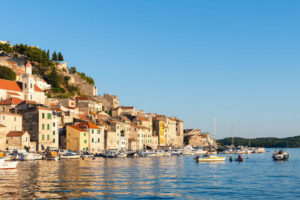
Find your route to island Prvic here.
Find more about Sibenik here.
Read more about this property here Croatia Sibenik island Prvic waterfront house for sale.
(L-OR-PE67)
Building land for sale with sea view, Orebic, Peljesac
LAND HAS BEEN SOLD!
Land for sale in Orebic. Beautiful nature and fresh air. Panoramic view of sea and island. Quiet and isolated place. 976 m2.
Pelješac (local Chakavian dialect: Pelišac; Italian: Sabbioncello) is a peninsula in southern Dalmatia[1] in Croatia. The peninsula is part of the Dubrovnik-Neretva County and is the second largest peninsula in Croatia. From the isthmus that begins at Ston, to the top of Cape Lovišta, it is 65 km long. The name ‘Pelješac’ is most likely derived from the name of a hill above town of Orebić, which is Pelisac. This is a relatively new name for the peninsula. Throughout history other names have been used such as Stonski Rat, Puncta Stagni, Ponta di Stagno and Sabioncello. The main town of Peljesac is Ston which has large fortifications, built by the Republic of Ragusa (Dubrovnik) [2]. They are the second longest walls in Europe and perhaps one of the oldest salt planes in this part of the world.
The Mali Ston Channel separates the peninsula from the Croatian “mainland”. The Strait of Pelješac is located at its far western end, and it divides the peninsula from the island of Korčula.
House for sale by the sea, Turanj, Zadar area
SOLD!
(H-TU-ZD45)
House for sale by the sea, Turanj, Zadar area are is situated in a little settlement near the Zadar town. This great house is only 50m away from the sea, just few steps away. This nice house for sale has a terrace with a breathtaking view of the beach and on paved courtyard. In front of the house there is a small garden with flowers. The garden is decorated so you can relax and find peace when retreating in the nature, when lying on the terrace you can enjoy the summer breeze and a smell of the clean sea. This nice house for sale has two floors. On the first floor there is a small kitchen, four bedrooms and two balconies. Each room is air-conditioned and has en suite bathroom. In the ground floor there are two bedrooms, a bathroom, living room, kitchen, internal stairs to the first floor, and a small pantry. The first floor has a separate entrance and also ground floor. It also has the ability to moor the boat. It also has a water tank of 50,000 liters with which to supply the whole house.
Zadar is a beautiful, 3000 years old centre of North Dalmatia, resting on the coast of the Adriatic sea that will give you an opportunity to testify its vivid history and enjoy the contemporary aspects of its culture today. Zadar evolved a lot through the years, transforming itself from a prehistoric settlement to an Illyrian village to a Roman municipality and surviving other transformations until it was finally liberated and reunited with the rest of Croatia in 1993. As the Croatian National Tourist Board says, the region of Zadar tells the story of the sources of Croatian cultural heritage better than any book.
If you want to know more about Zadar, click here: Zadar
Information about buying property in Croatia find here: Buying procedure, costs and fees